Showing posts with label chana dal. Show all posts

Sunday, October 24, 2010

Burmese Khow Suey (Kauk'swe)


I discovered Khow Suey quite late - the first time I tasted it was in a friend's house in Chennai. Her mother is an expert cook and she had made this dish for dinner. My friend's Dad was in the merchant Navy and had travelled a lot around the country. Her mother learnt to make this dish when they were posted in Calcutta. I was very, very impressed with that delightful mix of flavours I tasted that day - the creaminess of the gravy, the lovely array of toppings which made it a sort of a customised delight for oneself (while still letting someone else do the cooking!) and of course my undisguised love for coconut milk. The next time I tasted Khow Suey, was also in Chennai - in a delightful, little restaurant on TTK Road in R.A.Puram called Stop at Sam's (which sadly closed down) which had quite an eclectic menu. The fact that I got to meet and speak to my only fav B town hero Aamir Khan (those were the days he was dubbing for Lagaan) , may have added to my memories of the dish, but it definitely left me hankering for more.(The dish not Aamir).

But its been after coming to Delhi that I have really been able to eat Khow Suey to my heart's content. The Kitchen at Khan Market - run by the same team which manages Ploof and Blanco - serves up an excellent Khow Suey and I don't think we have managed to try much of the other items on their menu because their Khow Suey is so heavenly. They have managed to crack the code completely - not too cloyingly thick, not too sweet, not bland at all - a perfect blend of flavours which pleases the palate. Their Khow Suey counter was running well into a hundred thousand, the last time we visited. I have heard rumblings that the one at the next door Market Cafe is better, but why miss with perfection, really?! Unless of course, we are talking of the Khow Suey cooked by one of my friends in Delhi - I would abandon all pretensions of loyalty to have the one she slaves over for a couple of hours, till it is just right.


 It was after quite a while therefore, that I even decided to try this at home....I am still tinkering with recipes to create my version of what is just right - Khow Suey is perfectly suited for tinkerings, there are as many recipes there are people who love it. The main ingredients are coconut milk, onion, ginger, garlic and lentil paste for the creamy consistency. The piece-de-resistance, according to me though, are the toppings - the noodles of course are much the main dish; and then boiled eggs, chillies, lime juice, crushed peanuts, fried garlic - you can add as much or as little of what you want to create YOUR perfect dish. Soupy noodles? or noodles with a bit of gravy. More heat? Less tang? medium crunchiness? NO annoying add ons between you and your dish? As you please. It makes for a perfect dish to have on a party menu, precisely for this reason.

This time I have played around with this recipe I found on the Food Fairy's blog. I brought down the proportion of lentils considerably to suit our taste, but I did think that the idea of using lentils itself was much better than the gram flour (besan) which is usually recommended. It lends itself far better to melding with the coconut milk than flour does. It also does not mask the taste of coconut milk like gram flour might. I also increased the chilli powder, since between the lentil paste and the coconut milk, the heat just wasn't coming through.

For the toppings, I added chilli flakes and fried garlic to the toppings - I would also recommend chopped spring onions since it lends a lovely crunch to the dish. Hubby loves green chillies while I like red chilli flakes and our daughter loved the boiled egg. I also marinated the chicken for a bit and it absorbed the flavours of the curry beautifully - I would definitely recommend doing this, though since it cooks for quite a bit, its not really necessary. The lentils were cooked in a pressure cooker instead of on the stove top and this saved a lot of time; plus I didn't have to puree the lentils, just whipped them and they were smooth.
With the weather turning cooler, this is a perfect dish to have. The combination of noodles drowned in a delicious, creamy curry topped with some piquant bites of this and that makes this one of those irresistible meals where you can keep going on and on.

I am sending this to Nupur's Blog Bites 8 - the latest edition is themed around One Pot Meals. While I usually don't write out the recipe for this event since the intention is to share recipes from other blogs, I have adapted this a quite a bit and have just written the quantities out for my own reference, while I go about trying to see what happens as I tweak things around a bit. Do however, visit the original post for Malini's step-by-step recipe complete with pictures.

Burmese Khow Suey
(adapted from a recipe from Food Fairy)


Egg Noodles - 1 packet, boiled in lots of salted water, tossed in 2 tbsp of hot oil in a wok for 2 minutes and kept aside. (Next time I will use thinner noodles, like the ones you get ready made in Delhi's local markets)

Chicken - 250 gm of boneless chicken chopped into cubes and marinated in a mixture of lemon juice, salt and a pinch of turmeric for half an hour.
Oil - 1 tbsp

2 onions chopped
1" ginger piece chopped
10 small cloves of hill garlic or  6 big cloves of garlic chopped
2 green chillies chopped
To be sauteed and ground to a paste.


1/2 cup chana dal soaked in water for 1 hour;
 then pressure cooked with turmeric in 5 cups of water for two whistles and 3 minutes on low. Remove, drain a little of the water and reserve and whip the lentils till smooth. I kept adding  a little of the reserved lentil water as and when the curry thickened, since we like to have it thinner.

Coconut milk - extracted from 3/4th of a big coconut (about 350 to 400 ml)

Chilli powder -  1 tsp or more, according to taste
Chicken stock cube - 1

Coriander leaves for garnish
Salt - to taste

Detailed recipe - here 

In short, the chicken needs to be sauteed with the onion paste and then simmered with the lentil puree, seasonings and coconut milk for about 20-25 minutes till smooth and creamy. Water down as needed and keep stirring from time to time.

Wednesday, April 23, 2008

Kataachi Aamti - Spiced Lentil Stock Soup


Growing up in Mumbai and spending a lot of time in my neighbour's house meant that I was eating more of poli thup, varan bhath, usal and shikran more than idli and sambar! And though I resolutely refused to have rasam at home (didn't take a liking to it till much later in life) I used to love the aamti Patankar Aunty used to make.

Aamti is a staple of Maharashtrian cuisine and while it can also refer to other gravy dishes, it usually describes a lentil preparation with a wonderful mixture of spicy, sweet and sour notes. I loved the consistency - not as thick as sambar and not as thin as rasam - just perfect to be eaten with steamed rice or chapattis.

The tempering, the dals used, the spice mix, the proportion of jaggery and kokum or tamarind - all this produced a lot of variations of aamti. Different regions and different families have different recipes just like we have different types of sambar all over South India. Read more on Nupur's wonderful A-Z series

I of course didn't know much about the different kinds of aamti at that age. It was only much later when I started cooking, that I naturally tried making many of these recipes which were a big part of my childhood memories (and which of course you didn't get in restaurants unless you were sitting in one of those small eateries in B.B Dadar or Parel!).

One of the recipes I came across was Kataachi Aamti - a dish made from the lentil stock in which the chana dal, used in filling Puran Polis, was cooked. Puran Polis are another much loved Maharashtrian delicacy - deliciously sweet flaky stuffed flat breads - see one yummy version complete with pictorial here

My first Tamil New Year in Chennai after marriage saw me really homesick for Mumbai and since we anyway make "sweet bolis" as a festival dish I decided to make it the Maharashtrian way. The difference being that we use maida for the "bolis" and a coconut and jaggery filling while puran polis use wheat flour and a much drier chana dal and jaggery/sugar filling.That was the first time I made Kataachi Aamti, using a recipe I found in Femina.

I have made it many times after that, but without the puran poli bit....
This light soupy dish is perfect for the summer and you don't have to make puran poli to make the aamti! Just use the chana dal for some other preparation like a kootu or a tempered dal.

I am sending this dish to the April edition of Think Spice. This wonderful series which was begun by Sunita of Sunita's World has covered spices like mustard, ginger, saffron and star anise over the past six months and introduced us to a veritable feast of recipes showcasing the star spice of the month and its unique properties.
Sunita has now graciously extended this series to the rest of the food blogging world and from this month onwards Think Spice will be guest hosted by other food blogs. Gretchen of Canela & Comino hosts Think Spice - Cloves this month all the way from Peru!

My earliest memories of clove are not from food but seeing my Dad sucking on some clove after a rich meal to freshen up his mouth and my brother being asked to suck on a clove to tide over a toothache till he could get to the dentist the next day.

This aromatic spice (among others like pepper, cardamom and cinnamon) has been a precious commodity since time immemorial - wars have been fought, countries annexed and monopolies created for this spice which was worth its weight in gold! It has penetrated different global cuisines today and is easily available - but what you may not know is that besides its culinary uses it has so many other properties - antiseptic, analgesic, antispasmodic and even anaesthetic!

Clove imparts a very distinctive flavour to this dish and is a perfect example at the way it makes itself at home in almost all cuisines across India.

Kataachi Amti


Ingredients:

5-6 cups (1.2 litres) of chana dal stock
(cook about 2 cups of chana dal in 8-10 cups of water till it is soft, drain water and use for this recipe; the cooked chana dal is usually used to make the filling for puran polis but you can also temper it to make a dal accompaniment or add vegetables like cabbage, chow chow or bottle gourd (ghiya/sorakai/dudhi) to make a more substantial accompaniment.

Tamarind (imli) - lemon size ball soaked in 1 cup water
Sprouts - 1/2 cup (the original recipe called for 2 drumsticks cut into 1 " pieces)
Crushed jaggery (gur/vellam) - 2 tbsp
Dry coconut sliced (copra) - 1/4 cup
Cumin seeds (jeera)- 1 tsp
Chilli powder - 2 tsp
Goda masala - 1 tsp ( a Maharashtrian spice mix)
Salt to taste

Tempering:
Oil - 2 tsp
Cloves (lavang) - 5
Cinnamon - 1 " piece
Cumin seeds (jeera) - 1/2 tsp
Mustard seeds (rai) - 1/2 tsp
Curry leaves - 6-7


Method:

1. Extract tamarind juice and add to the dal water. Heat the dal water in a kadai(wok) and bring to a boil. Add sprouts and boil for 3-4 minutes till half cooked.

2. In another pan, roast cumin seeds and dry coconut for about 4-5 minutes on a low flame, cool and grind to a fine paste.

3. Add chilli powder, salt and jaggery to the dal water and boil for 3 more minutes. Add the cumin coconut paste and goda masala and simmer for another 4-5 minutes.

4. Heat oil for tempering in a small pan and add the mustard seeds, when they pop season with cloves, cinnamon, cumin seeds and curry leaves. Pour the seasoning over the simmering aamti and turn off heat.

5. Serve hot with steamed rice , chappatis or puran polis. The consistency is very watery as compared to most other lentil dishes and is very conducive to slurping right from the wati (bowl) in which it is served!!


Monday, November 26, 2007

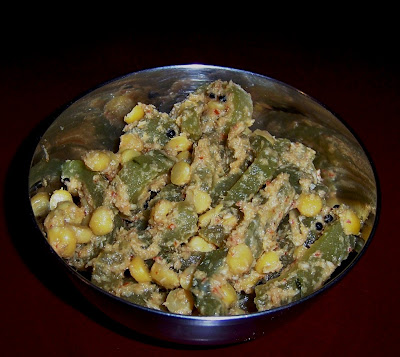
Podalangai Masala (Snake Gourd & Lentils)

One of the recipes I learnt from my MIL was one which was prepared, not in her maternal Mudaliar home, but by her MIL who was from Thanjavur. The base recipe for the masala was used with some other vegetables like raw banana and yam, but I liked it best when it was made with snake gourd.

Snake gourd otherwise has limited preparations that I know of, the bland poriyal category – for which I feel it isn’t crunchy enough; the chana dal kootu or dal – where it usually completely loses its character and merges with the soft lentils- and the stuffed version which is quite time consuming.

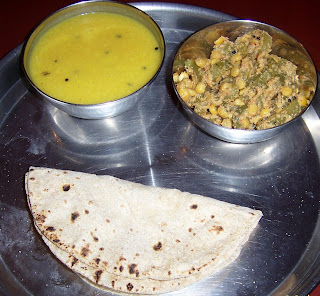
This preparation allows the snake gourd to retain it colour and at the same time spices it up with the aniseed flavoured masala. Traditionally it is a dry accompaniment to the sambar/kozhambu, rasam meal, but I have found that it also pairs well with chapattis and my husband loves carrying it in his lunch box.


The chana dal to snake gourd proportion can be adjusted according to one’s preference, I prefer more snake gourd to chana dal so that the spiciness isn’t dulled by the dal.


Podalangai Masala (Snake Gourd & Lentil Vegetable)


Ingredients:

Snake Gourd – ½ kg
Chana Dal (Split Bengal Gram) – ½ cup (soaked for 1 hour)
Masala:
Dried red chillies – 4
Aniseed (Saunf) – 1 tbsp
Grated coconut – ¼ cup
Salt – to taste
Tempering:
Oil – 1 tbsp
Mustard – 1tsp
Curry leaves – 5-6

Method:

1. Wash and peel the snake gourd, then slice it vertically into half. Remove pith and seeds and cut into semi circles horizontally.
2. Cook the chana dal in water till just tender, it should not get overcooked and mushy. You can cook this on the stove top or in a pressure cooker for just one whistle. Ideally, it should still have a little bite to it so that it can cook some more with the masala and the snake gourd.
3. Grind the masala ingredients to a paste adding a little water adding as little water as possible.
4. Heat oil in a kadai/wok; when hot add mustard seeds and when they pop add the curry leaves.
5. Add the chopped snake gourd and stir fry for 3 minutes on high. Then reduce flame, add the masala and fry for 3 minutes more.
6. Add salt and ½ cup of water or just enough to cover the snake gourd, cover and cook on low for 3-4 minutes till the snake gourd is half cooked.
7. Add the cooked chana dal to the half cooked snake gourd, adjust salt and then cook for another 5 minutes till the snake gourd is fully cooked and the masala becomes dry and chana dal is soft and mixes well with the vegetable and masala. Add a splash of water if needed.If there is excess water; increase the heat so that it dries up.

Note: The chana dal shouldn’t get mashed, so if it is already very soft after cooking, then it should be added right at the end to the vegetable and not stirred too much, so that it remains whole and doesn't fall apart.


Phulkas, Masur Dal and Podalangai masala

Edited to add: Some people asked me about snake gourd and how it looks etc, so I am posting a pic of the one half I had left, unpeeled and the insides too.