Showing posts with label okra. Show all posts

Monday, March 3, 2008

Vendakkai Kozhambu (Okra in spicy tamarind gravy)


Kozhambu in Tamil usually refers to a gravy made without lentils (dal) in it. While it often refers to a tamarind based gravy like Puli kozhambu or Poondu kozhambu, it also includes the buttermilk based gravy - Mor kuzhambu. And though some think of it as sambar without dal, I prefer to think of sambar as kozhambu with dal in it - after all tur dal came to South India much later and it was tamarind which ruled the roost for a long time.

Depnding on what we are used to calling "kozhambu" at home, a thin spicy meen kozhambu (tamarind based fish gravy) may be what it recalls for some, while others will associate it with the thakali kozhambu (tomato curry) their mother used to make with idlis for breakfast.

My mother is an expert at the correct spices and tempering to be used for various kozhambus, while I am still learning as I go. But when I yearn for "something" after a particularly nasty bout of viral flu which seems to have deadened all your olfactory senses, then a nice spicy tangy kozhambu is just the ticket to open up that stuffed nose and heavy head!

And my favourite is the one made with okra in it; this vegetable which has an (undeserved I may add) reputation for stickiness when cooked on its own, somehow plumps up into juicy fingers which go squelch! in your mouth when you bite into them, spilling all the tangy goodness of the kozhambu it has absorbed.

Served with steamed rice, some plain tur dal with the simplest of tadkas and a lovely red potato "roast" - this really made our Sunday lunch a heartwarming affair!

Vendakkai Kozhambu (Okra in Spicy Tamarind Gravy)


Ingredients:

Okra (lady fingers/ vendakkai) - 6-8 tender small ones
Tamarind extract from one small lime sized ball of tamarind - 1/2 cup
Onion - 1 big chopped
Tomato - 1 quartered
Garlic - 3-4 cloves
Oil - 1/2 tbsp veg oil, 1/2 tbsp sesame oil

Tempering
Mustard seeds - 1 tsp
Fenugreek seeds (methi) - 1/4 tsp
Asafoetida (hing) - pinch
Curry leaves - 6-7

Masala:
Red chillies - 4-5
Coriander seeds (Dhania) - 1 tbsp
Fennel seeds (Saunf) - 1/2 tbsp
Fenugreek (Methi) - 1/4 tsp
Peppercorns - 1/2 tsp
Grated coconut - 1/4 cup
Method:

1. Wash and thoroughly dry the okra with a kitchen towel. Cut the tops and the ends of the okra, and chop into 1 " pieces.
2. Dilute the tamarind extract with 350 ml water and keep aside.
3. Roast all the ingredients for the masala in 1 tsp of oil (add coconut last) and when browned and aromatic, take off flame and cool. Grind to a smooth paste, adding a little water at a time.
4. Heat oil in a kadai, add mustard and when it pops, add the fenugreek seeds, asafoetida and curry leaves.
5. Put in the chopped onions and saute 5 minutes. Add the garlic and saute another 2-3 minutes.
6. Add the chopped okra and fry for about 8 -10 minutes on a low flame till it softens.
7. Add the tomatoes and pour in the tamarind extract; mix in half of the masala paste and salt to taste and bring to boil, reduce flame and simmer covered for about 10 minutes till the raw smell of tamarind goes away.
8. Add the remaining masala paste and some more water if needed, bring to a boil and simmer for another 5 minutes.


Tuesday, November 6, 2007

Puli Kozhambu

Tamarind is the fruit of the Tamarind tree (Tamarindus Indica) and is native to tropical Africa.It reached India a long long time ago and then the Persians and Arabs who called it "tamar hind" or "Indian date".Most of its colloquial names are variations on the common English term. In Spanish and Portuguese, it is tamarindo; in French, tamarin, tamarinier, tamarinier des Indes, or tamarindier; in Malaya, asam jawa; in India, it is tamarind or ambli, imli, chinch, etc
The food uses of the tamarind are many. The tender, immature, very sour pods are cooked as seasoning with rice, fish and meats.The ripened fruit pulp is edible and popular as a spice in Latin American and Asian cuisines.
Above info,picture and more on tamarind from here

My earliest memory of tamarind is when I was about 7 or 8 years old, in my paternal grandfather’s house in Trichy, collecting the seeds so that I could rub them on the floor till they were hot and then press them on an unsuspecting cousin’s hand and quickly run away as they let out a surprised yelp! The same magnificent tree was the one under whose cool shade we used to rest on scorching summer afternoons with our library books.

Tamarind is the base for many South Indian dishes and even to non South Indians who are aware of this, it never ceases to surprise them that there is a dish like this which is based solely on it; no dal added like in Sambar, no ground masala with coconut to balance the sourness – Puli Kozhambu.
In Tamil, Puli means tamarind and Kozhambu is a generic term for curry(gravy) dishes. Well, my Dad had an English translation for this dish which used to annoy my mother to no end – “Ah!Tiger Broth!” he would say, snickering at his own joke – “Puli” in Tamil, pronounced slightly differently means "tiger". It's one of my comfort foods today and I still remember that joke.


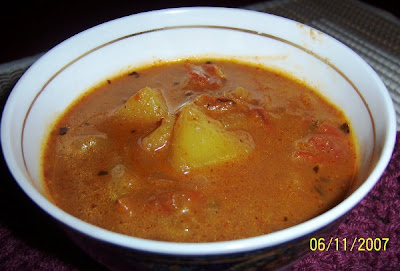
Puli Kozhambu (Tamarind based Spicy Curry)

Ingredients:

Pumpkin – 100gm, peeled and chopped into 1” squares
Garlic – 6-8 cloves
Onion – 1 big, sliced or 1 cup shallots peeled
Tomatoes – 1 big chopped
Thick Tamarind pulp – about 150 ml (Soak a lime sized piece in warm water, squeeze to extract pulp and filter)
Coriander (dhania) powder – 3 tsp heaped
Chilli powder – 2 tsp
Salt to taste
Veg. Oil – 1 tbsp
Til Oil – 1 tbsp

Tempering (Thalimpu)
Mustard (rai) – 1 tsp
Fenugreek (methi) seeds – ½ tsp
Asafoetida powder (hing) - pinch
Curry leaves – 6-7

Method:
1.Cook chopped pumpkin in water till 3/4th done. Peel garlic and crush lightly
2.Heat a kadai(wok) and add both the oils, when it heats up, add mustard.Wait for the mustard to pop,then add the fenugreek seeds and asafoetida , as soon as the seeds change colour, add the washed curry leaves. Reduce heat, add garlic cloves and fry on low for 3-4 minutes.
3.Add sliced onions or whole shallots and sauté on low till translucent. Add the chopped tomatoes and fry till pulpy.(about5 minutes)
4.Add the coriander powder and chilli powder and fry 1 minute. Add tamarind pulp along with 100ml water and salt and bring to a boil. Once it is boiling, add the chopped pumpkin and reduce flame to medium. Cover and cook for 10-15 minutes till the tamarind is cooked and doesn’t smell raw. Adjust the salt and cook for 5 - 10 minutes more till the gravy is reduced to little more than half.
5.Serve with steamed rice or dosais.

Note: Pumpkin makes this dish a bit sweet which I like because the gravy itself is sour and spicy and that makes for a good mix of flavours. But if you (like my husband) don’t prefer the sweetness to intrude on the spice, you can replace pumpkin with:


-Sticky potato/Colacassia (Arvi)boiled and cut into 1" pieces
-Okra -1" pieces lightly sautéed
-Vadaam – sun dried balls made out of a mixture of urad dal flour,spices and salt with a lot of variations which include onions and ash gourd pieces.Used to be handmade at home, but now is readily available in most grocery stores. They are fried as part of the tempering before adding to gravies and add an instant burst of spice and flavour.