Showing posts with label peas. Show all posts

Wednesday, April 30, 2008

Green Peas Pulao - Jihva for Love


This post is a departure from my usual way of blogging - I often find it hard to cook specifically for an event.....well this time I am blogging especially for the Jihva event. This month's event is being hosted by Pratibha and Jigyasa on their spanking new blog dedicated to Pedatha.

Jihva is a food blogging event which was begun by Indira of Mahanandi and focuses every month on one ingredient. This month's ingredient is a fitting tribute to the memory of Pedatha - it's that ever so intangible thing which makes each home cooked meal a comforting one - LOVE.

When they asked us to blog about the one person whom we really love and honour in our lives - I found it so difficult to choose. My life is filled with people who have touched it in so many different ways and with so much of love that I couldn't imagine a life without them.

So, I wondered (being a true Gemini) how I could choose just one person. These people are difficult to separate from the person I am. They make me complete in their own unique way.

My biological mother - Amma - of whom I have very few memories; she passed away when I was five.
My mother who raised me to be an honest, responsible and caring person and broke all the stereotypes about stepmothers.
My father who is the best father ever - there is nothing I can't talk to him about, he has always stood by me - even when he didn't agree with me.
My husband who is my Rock - the one who nursed me through my illness, fought alongside me and believed that I would make it, when so many others didn't.
My daughter who has brought new meaning into my life and made us give thanks every single day for the beautiful blessing that she is.

BUT there is one other person, not part of my family, but as dear and respected to us - without whom I wouldn't be here today.

My surgeon - the most sincere and forthright person I have known. He did everything in his power to keep me alive when other doctors were just looking to add a "rare case" to their records. He experimented, researched, kept me going with some path breaking methods of nutrition and then performed a surgery that he truly believed would be best for me - not for the money, not for the "case sheet", but for me. I am here today, so I guess he succeeded!.
Tragically he died last year of cancer and I was left ranting at the unfairness of it all - one so young and so dedicated to his profession should have had more time...

This is my tribute to him through Jihva for Love. I don't know whether he would have actually liked this dish - the only thing I have made for him is coffee when he visited home (yes, he made house visits just for me!!).

But since it is one of the few things I remember my mother making (the others being a tomato raita and an egg curry) I would like to think that the one who brought me into this world and the one who gave me a second life might have similar tastes....


Peas Pulao
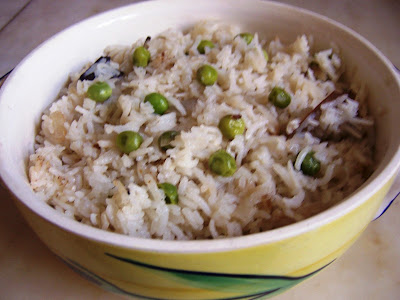
simple and satisfying - served with vegetable kadhi and stuffed eggplant

Ingredients:

Basmati Rice - 1 cup soaked in 3 cups water for 15 minutes
Peas - 3/4 cup
Cinnamon stick (laung) - 2 " piece
Bay leaf - 1
Cloves - 3-4
Cardamom - 2
Onions - 2 medium sliced long
Ghee - 1/2 tbsp
Oil - 1 /2 tbsp
Salt - to taste

Method:

1. Take a non stick pan and heat the ghee and oil together. Add the whole masala - cinnamon, bay leaf, cardamom and cloves and wait till they change colour.Add the cumin seeds and saute half a minute, then add onions and saute till golden brown.
2. Drain and add the rice and peas and saute 1 minute, then add the drained water and bring to boil. Add salt.
3. Lower flame to medium and cook uncovered for about 10 minutes. Stir the rice just once in one direction and check to see whether it is cooked.
4. Cook for 3-4 more minutes; the rice grains should be cooked and separate, but not mushy. Turn off flame and cover till serving time.

If the rice isn't cooked for some reason, add hot water only one fourth of a cup at a time. The rice will continue cooking when it is closed, so allow for that extra cooking time.

If using frozen peas, add them halfway through since they are already cooked.

Sunday, January 20, 2008

Shaak - Winter Vegetables Gujarati style


Growing up in Mumbai, and particularly in an area where there was a predominantly Gujarati population, I ate a lot of Gujarati food - especially in school; my friend's dabbas were the most delicious ones on the block.
And unlike most of us who carried our lunch boxes packed in the morning, theirs would usually arrive steaming hot during lunch time, delivered by a dabbawalla or a family member.

What with my Dad being a complete foodie, we were also treated to visits to Thakkers in Central Mumbai, where their unlimited thalis were the most sumptuous meals one could imagine. They would lovingly ply us with those rotlis (small sized chapatis) topped with a generous spoonful of ghee, accompanied by a variety of daals, kadhis and shaak, till we could hardly breathe.
In summer there would be the dreamy aamras - golden mango pulp from the freshest Alphonso mangoes - to go with fluffy puris. This for me was even more coveted than the shrikhand (sweetened hung curd) which usually accompanied the puris.

And trains.....yes, trains were an unlikely place, but thats where we got our annual dose of Gujarati snacks, pickles and travel food, when we visited my grandparents down South.

The journey used to take a good 2-3 days then, and while we had lime rice, curd rice, tamarind rice and potatoes packed to last us for about a day and half surviving on station food and (awful) train "meals" after that, the Gujarati families we met (and became instant friends with their kids sharing Amar Chitra Katha comics and video games!) used to seemingly come prepared to feed the entire compartment for the next 4 days!

There was farsaan - theplas, khakras et al accompanied with chundo and green chutney, complete meals of rotlis and dry shaak, and of course sweets. What's not to like! especially since after a point the only way to entertain children in closed compartments is to ply them with food and hope that they sleep it off!

Gujarati cuisine comes from the NorthWestern state of Gujarat and is mainly vegetarian. It changes a lot from the coastal regions to the dryer interior regions, but the cuisine on the whole is centred around wheat breads,pulses and lentils, yoghurt based preparations and seasonal vegetables cooked with spices - either lightly steamed or shallow fried. Many of the dishes have a hint of sweetness to them, but there is a misconception that all Gujarati food is sweet. Sweets are much liked and along with snacks provide for a huge number of interesting regional recipes. While some of them are deep fried, there are also quite a few snacks which are steamed and very tasty. Read more about Gujarati cuisine here and more recipes on one of my favourite blogs; she hasn't posted in a while and I'm hoping she can come back soon....

Its been a long time since I cooked any Gujarati food....I remember cooking a lot of it when I got married and I used to miss the dhoklas, khandvi etc of Mumbai. I even made undhiyu once for Tamil New Year instead of the traditional 7 vegetable sambar, much to the consternation of MIL :)

I came across this recipe of Tarla Dalal recently and given that it seemed to be perfect for the winter vegetables available now, I set about making it with a few alterations.

Initially it sounded a lot like the famous dish Undhiyu - but it's a lot less complicated; the veggies don't need to be stuffed. I haven't come across this dish anywhere else though, atleast not by the name Panchkutyu Shaak - though it says its a traditional Gujarati recipe.

Purple kand in Delhi doesn't seem to be common and I substituted with elephant yam or suran.
Broad beans which are in season,instead of french beans also seemed like a good idea.
I added raw bananas to the recipe and used one big potato instead of baby potatoes and omitted the sugar in the recipe.
I also did not deep fry the muthias, preferring to steam cook them as in this recipe.

The dish with its mix of vegetables cooked together in the spice mixture tasted delicious; in some ways it could be compared to an avial, but it was bursting with a lot more flavour and the dhana jeera powder gave it a very distinctive taste.

Shaak - Winter Vegetables Gujarati Style


Ingredients:
Elephant yam or suran peeled and cubed - 1/2 cup
Broad beans - 1/2 cup cut into 3-4 pieces each
Ridge Gourd (turai/Peerkangai) peeled and sliced thickly - 1/2 cup
Peas - 1/2 cup
Raw Banana peeled and sliced thickly - 1/2 cup
One big potato - peeled and cubed - 1/2 cup

Tadka:
Cumin seeds (jeera) - 1 tsp
Mustard seeds (rai) - 1 tsp
Asafoetida (hing)- a pinch

Grind to a paste - 3 green chillies and 2 ' piece of ginger (cut down on chillies to lessen spiciness)
Reserve 1 tsp for muthia.

Dhania jeera powder (a staple in Gujarati kitchens) - 2 tsp
I used 1 tsp of jeera (cumin) powder and 2 tsp of dhania (coriander) powder

Turmeric powder - 1/4 tsp

Grated coconut - 1/2 cup
Chopped coriander - 1/2 cup

Oil - 1 tbsp
salt to taste

Methi muthia:

Wheat flour - 4 tbsp
Gram flour (besan) - 2 tbsp
Fresh fenugreek leaves (methi) - 1/4 cup washed and chopped
Oil - 1tbsp
Salt to taste
Ginger green chilli paste - 1 tsp
Turmeric powder (haldi) - a pinch
Asafoetida powder (hing) - a pinch

1. Mix all ingredients of muthia and make a dough adding as little water as is required.
2. Divide the dough into 6-8 portions and make small cylindrical rolls out of it.
3. Steam these muthia for about 10-15 minutes till they are well cooked- this is if you are using a stove top steamer where the water is brought to a boil and then the steamer with muthias kept inside on the stand. If using the microwave steamer, the cooking time will be much less.
4. Once done, cool and keep aside.

For the shaak:
1. Heat oil in a pan and add mustard seeds, when they pop add the cumin seeds and the asafoetida.
2. Add the chopped vegetables except the peas, ginger chilli paste, dhana jeera powder and turmeric powder. Saute for 3-4 minutes , then add 2 cups of water and bring to a boil, simmer and cook covered till the vegetables are cooked and the dish is almost dry.Halfway through add the fresh peas to the dish.
4. Add the coconut,coriander, muthias and cook for 2-3 minutes - if using frozen peas, then add the peas at this stage.
5. Serve hot with chapatis or rice.


Friday, January 18, 2008

Rosy Tomato Risotto


I first came across rosematta rice almost a year ago, on Mahanandi, in this post where Indira waxed poetic on this rich, beautiful, unpolished traditional rice from Kerala. I then saw it on Jugalbandi too - used in different recipes , each more beguiling than the other. The fact that both these talented bloggers (three actually) used rosematta to make these lovely idlis piqued my interest even more.

Then this year as part of our resolve to eat more healthily and to make healthier eating a part of our life rather than a diet which would fade away, I decided to try rosematta as an alternative to the white rice we consume. I have been thinking of brown rice for some time, and then thought I might as well try our own traditional rice first.

I bought it and looked wonderingly at those fat pink grains....and I thought to myself, for the first time I won't just cook these and try to eat it as part of our usual meal with a sambar or rice - that could come later when we were on more familiar terms - the first time I would treat it like a guest and make something suitably different and special!

I went over to Jugalbandi for some inspiration....and came across this post where they had one of Ursula Ferrigno's recipes - and there was another one called Risi e Bisi also from the same author.

While following this link from their post, I came across a recipe for tomato risotto which instantly appealed to me. I couldn't resist the plump peas I had just shelled, and added them to this recipe.

Cooking this rice risotto style was a bit longwinded, what with adding the stock one ladle at a time and waiting for it to be absorbed fully before repeating it, stirring it constantly; but I must say that it was completely worth it.

I soaked the rice for an hour before cooking;I omitted the parmesan, since I didn't really envision this as a Western dish, instead wanted to incorporate it as part of an Indian meal.

The white wine is an aberration in an Indian meal, but I could live with that.

I also followed J&B's recommendations to cut down on the fat content in the original recipe.

I made vegetable stock from scratch since I don't get a good quality vegetable stock cube hereabouts.

I served this with grilled aloo tikkis (potato cutlets) and a lovely raita made with grated bottlegourd (ghiya/lauki/sorakkai) and cumin spiced curd. It was a delicious meal and I loved the texture of the rice - firm and flavourful- a completely new experience for us.

The tomato flavour was just right too - not too tangy; and I'm glad I added the peas! The best part for me was the shallots - completely divine plump soft sweet pieces in a mouthful of rice!

This tastes best when eaten immediately, the leftovers I tasted the next day weren't the same.

Rosy Tomato Risotto

Rose matta rice - 1 1/4 cup, soaked for an hour

Vegetable stock - 6 cups - heat up the stock when you are cooking the rice.
To make veg stock from scratch, saute two small chopped onions with a 1 tsp butter, add 1 cup assorted chopped vegetables like potato, carrots,beans, cabbage,pumpkin and saute for 3-4 minutes. Add 1.5 litre water, salt and pepper powder and bring to boil; simmer over medium flame for about 20-25 minutes till the vegetables are well cooked and stock is reduced. Strain the vegetables and use the stock. Vegetables can be lightly sauteed, tempered and eaten separately.

Garlic - 3-4 cloves, crushed

White wine - 1/2 cup

Tomatoes - 6 medium sized, deseeded and roughly chopped

Peas - 1//2 cup

Olive oil - 1 tbsp

Butter - 2 tbsp

Shallots - 8 (I put them whole)

Mint leaves - 1/2 cup torn

salt - to taste

Lots of Freshly crushed pepper


1. Heat the butter and oil in a heavy pan till just warmed, add the shallots and saute for 2-3 minutes, then add the crushed garlic and saute for 1 more minute

2. Drain the soaked rice and add to the pan and if you are using fresh peas then add these also now; fry lightly for about 2 minutes.

3. Pour in the wine and keep stirring till it is absorbed.

4. Add 1 ladle of hot stock and simmer. Stir the rice and wait till the stock is completely absorbed. Repeat this for the next 10 minutes.

5. Now add the chopped tomatoes, mix well. Add the hot stock one ladle at a time as before, waiting for it to be absorbed before adding the next ladle - it will take another 10 -12 minutes for the tomatoes and rice to be cooked. The grains should be tender and plump, but not mushy.

6. Add the mint, salt and crushed pepper and give it a final stir, remove from heat, transfer to a warm serving bowl and cover and keep aside for a couple of minutes.

7. Serve immediately. I chose to make it part of an Indian meal and served it with ghiya raita and aloo tikkis.